
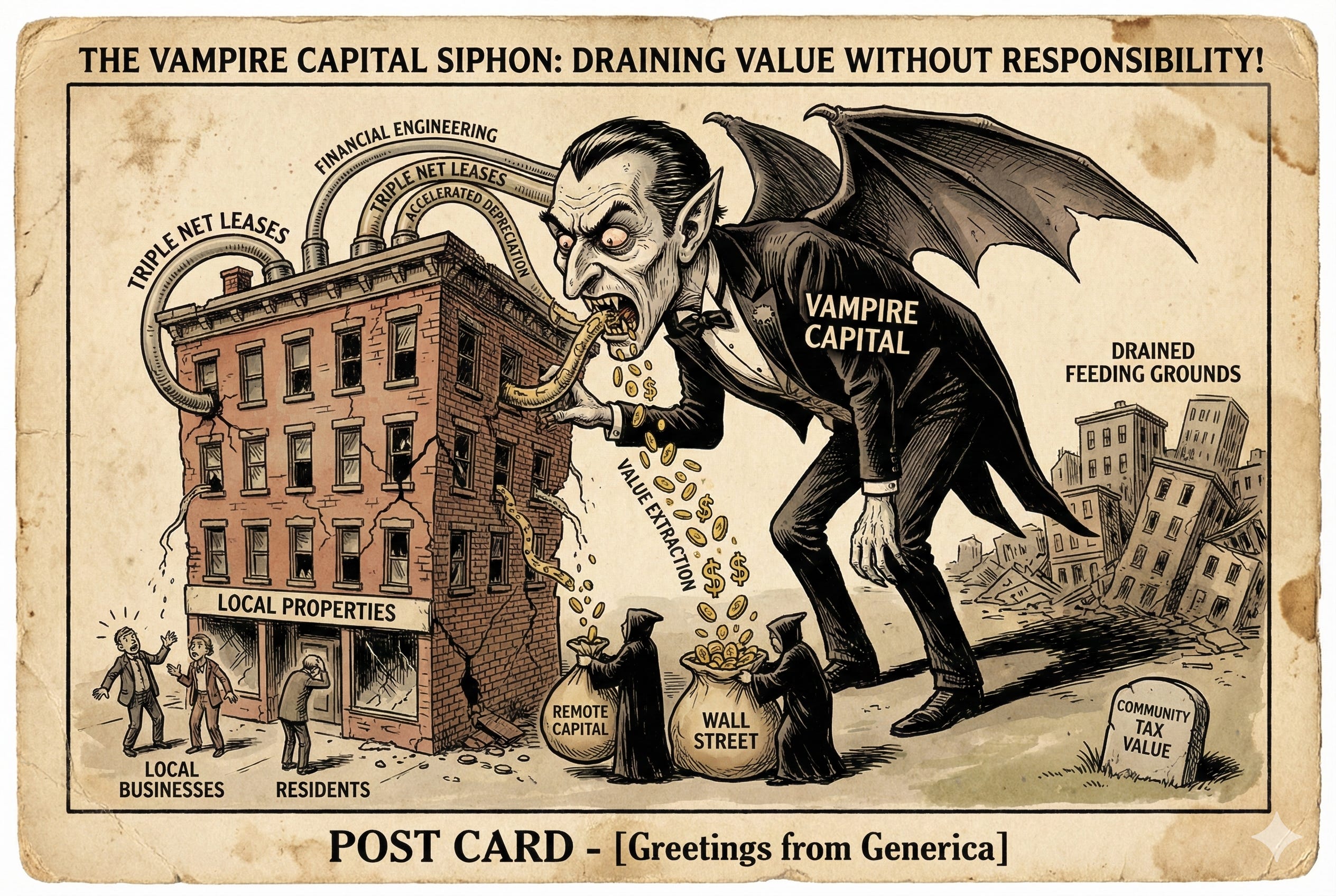
Vampire Capital: Designed to Drain, Built to Abandon
They used to build old buildings to last for generations, today, they are meant to last the length of a loan period.

“We’re not living in failed communities. We’re living in completed extraction sites.”
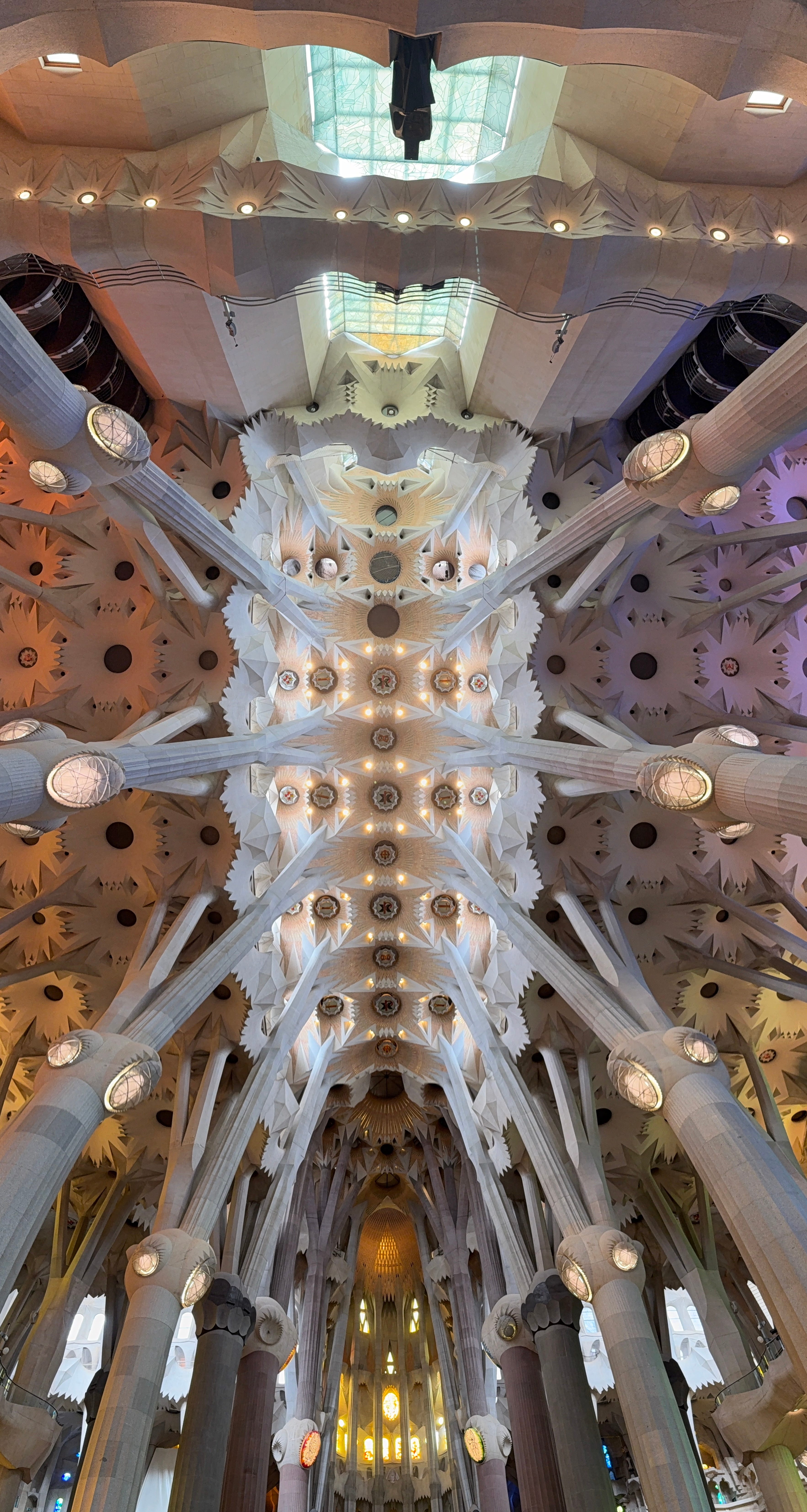
A couple of years ago I stood inside the Sagrada Família in Barcelona. I had always been fascinated with Gaudí and the story behind his most famous piece of architecture. Gaudí has been dead a hundred years this year, but they are still building his church, as he drew it.
They could have stopped building this and called it close enough. Funding this extravagant piece of architecture has always been a challenge. But they didn’t. They kept going. Gaudí wanted to give a cathedral to Barcelona that would last forever.
That’s how we used to build. Stone cut to last, details most wouldn’t notice, materials chosen to outlast the people who built them.
We don’t build that way now.
The easy answer is that we lost the craft, or the will, or the money. We didn’t. The reason is colder, and it has nothing to do with how we build. It’s that for the buildings we put up now, the value was never going to be in the building at all.
Drive home and look at what we build instead. The strip center with three dark bays and butcher paper over the glass. The mall down to one anchor and an ocean of cracked asphalt. The big box waiting on a county auction. The apartment buildings with walls that look like they may fall over with a good breeze.
None of them was ever worth what it looked like. The value sat in the rent and the write-offs, and that kind of value doesn’t stay.
They aren’t cheap buildings. They’re buildings built to a different standard, and one that is less about construction materials and more about financial spreadsheets.
This is what’s left after the vampire feeds.
— /// —
Two Kinds of Building
A strip center and a cathedral are both called buildings.
Gaudí’s church is a building in the way we most of us mean the word. Its value is the church itself, the stone, the space, the thing you stand inside, and that value is meant to be there in three hundred years.
The box on the corridor is something else wearing the same shape. Its value was never the structure. It was the income the structure could collect and the tax write-offs it could throw off, and neither of those was ever going to stay.
Call it Vampire Capital. Money that values the income, not the building. It attaches to a structure, drinks the rent and the write-offs for as long as they flow, and when they run dry it moves on, leaving the body, because the body was never what it came for.
We assume a building outlasts the people who finance it, the bank that lends on it, the chain that signs the lease. That’s where we were wrong.
Portable value leaves. What’s standing on your corridor is what it left behind.
— /// —
The Clocks
Ask how long a commercial building lasts and you really get four answers, because four clocks run on it at once and only one of them is about the building.
Sure, the concrete and steel will last sixty years, maybe more. But the tax code says thirty-nine is long enough. The anchor’s first lease says ten, maybe fifteen. The equity partners say they need it in five to seven.
Let’s start with the thirty-nine-year number. The 1986 Tax Reform Act put nonresidential structures at 31.5 years. In 1993 Congress stretched it to 39, partly to help pay for loosening the passive-loss rules for people who work in real estate.
This is the official lifespan of every commercial building in America. It is a revenue offset.
But nobody uses the thirty-nine anyway.
A cost segregation study takes the building apart on paper. Parking lot, site lighting, landscaping, signage, specialty wiring, millwork, fixtures, all of it comes off the 39-year schedule and onto five, seven, and fifteen year lives.
Then bonus depreciation expenses those components in year one. That provision was dying. It was down to 40 percent in 2025 and headed to zero in 2027, and then the One Big Beautiful Bill Act put it back to 100 percent, permanently, for property acquired after January 19, 2025. The IRS confirmed the mechanics in Notice 2026-11 this past January.
Anything with a useful life of twenty years or less gets written off immediately. The structure gets nothing. No bonus, no acceleration, thirty-nine years straight line.
Congress sorted the building into the part worth having now and the part that isn’t, and put the walls and the frame in the second pile.
The same bill wrote Section 168(n). Build a factory, elect qualified production property, and you expense the entire building in year one. Shell, roof, slab. So the code can decide a structure is worth building. It made that call for manufacturing and declined to make it for the corridor.
Then the equity clock. Deductions spent, property appreciated, the owner refinances, pulls the original cash back out, and puts it into the next building on a fresh schedule. Checks keep arriving. The capital is gone.
Year seven isn’t when the building dies. It’s when there’s nothing left in it worth taking.
The lease clock belongs to the tenant, and underneath it sits the net lease. Tenant pays rent, taxes, insurance, upkeep, and in an absolute net deal the roof and the lot too. The owner holds title and cashes the check.
Add them up and the concrete outlives every clock anyone is paid to reach. Call that gap the unpriced decades.
Twenty years, thirty, sometimes forty, in which no party to the deal has a reason to want the building to still be good. The structure spends them standing up.
— /// —
The Honest Building
Now go back and look at the materials.
People blame cheap construction, like we forgot how to build. Tilt-wall poured flat and stood up in an afternoon. Foam troweled on to read as stone from forty feet. A roof warrantied twenty years and not a day past.
Nobody forgot anything. You don’t build the container rich when the value isn’t in the container. Spend on a sixty-year wall and you’ve improved the one part of the deal that doesn’t pay. Rent doesn’t rise because the block will outlast everyone. Deductions don’t deepen. The sale price tracks the lease and the tenant’s credit, not the masonry.
Permanence comes out of the budget first because it doesn’t pencil. We have diluted our built environment to a spreadsheet in some accountant’s office.
A developer will tell you he wanted that center to last, and he means it. He really wanted the income to last. Keep the building up and you protect the income, and plenty of owners hold thirty years doing exactly that. The day the income can’t be saved, there’s no case left for spending on the building, because the building by itself was never worth much. Nobody decides to let one die. They decide, correctly, that the value had already left after the vampire sucked the last dollar of profit out of it.
— /// —
The Position Nobody Can Exit
The equity refinances out. The anchor runs its term and moves to the newer center up the road. The building gets bundled into a fund, sold to a yield buyer, sold cheaper to a value-add story, each trade sliding it one square further down the board. By the time the windows go to paper, it’s changed hands four times, and nobody who made money on it has thought about it in years.
The one party that can’t refinance out is the town.
It approved the thing on a fiscal study that modeled the good years and stopped needing to count. It got the ribbon cutting and the first decade of taxes. Then it inherited the unpriced decades. The vacancy, the cracked asphalt lot, the blight that pulls down every parcel touching it, and eventually the demolition bill. Empty, the shell is worth the land minus the cost of knocking it down.
Second lives don’t reverse any of this. When the value of the neighborhood starts to wane, the dead box becomes a church, a county annex, a climbing gym.
A second life is a new stream of rent and write-offs draped over an old shell on worse terms than the last, and the thirty-nine years starts over on the new work while the tenant comes in a step down from the one before.
You’re thinking your buildings are fine. Leased, paying, nothing like a box with paper in the windows. That’s true and it doesn’t mean what you want it to. A working building tells you where you are on the clocks, not that the clocks skipped you.
— /// —
The Exit is Jammed
A trillion or so in commercial mortgages will mature in the next couple of years. A property that was refinanced at 75% of its value in 2019 now has 55% or 60%. The core strategy of extracting original equity and using it to purchase another property no longer works.
That only changes who’s holding the body. Capital that exited in 2015 is gone and isn’t coming back to help. What’s stuck is the last buyer in the chain, usually smaller, usually more local, usually the one who paid the most for the least.
The blight often arrives on the same schedule.
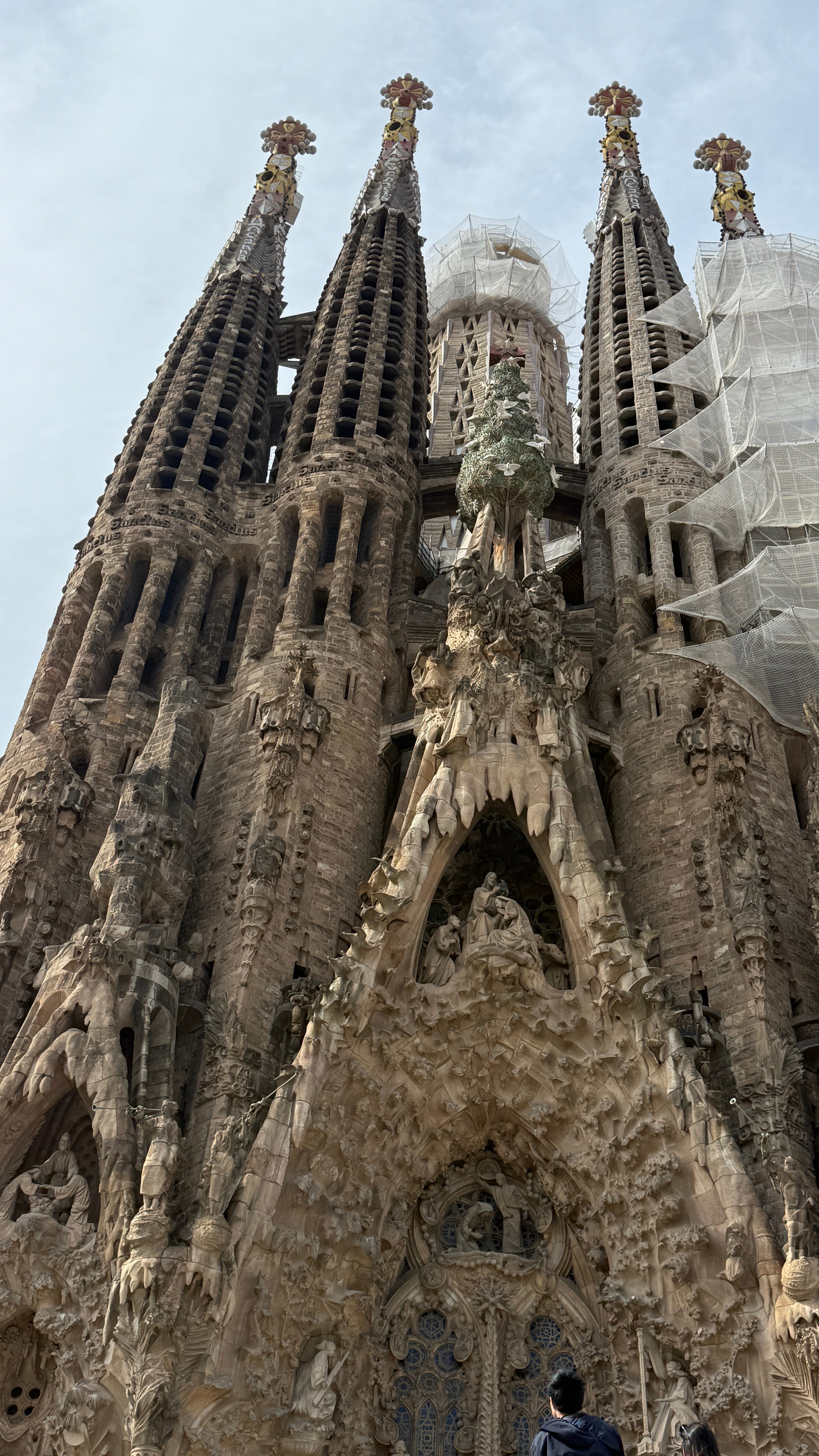
Sagrada Família is still not complete. The towers are now set, but the main entrance hasn't started. The construction work will continue, and the best estimate for completion is somewhere around 2034. Since 1882, the work has passed from hands that started it to hands that hadn't arrived yet, and to date, not one of them ever stood in a finished building.
Three miles from wherever you’re reading this, something is going up that won’t see forty, and nobody paying for it will be around to notice.
One building was built to outlast the men who made it. The other only had to outlast a loan.
— /// —
Missed an installment of Escaping Generica?
The Asphalt Stayed: How Sixty Years of Parking Minimums Built a Country Nobody Quite Agreed To — Jul 14
I Don’t Know the Ending: A Halfway-Point Confession — Jun 30
The Frequency Ladder: Why Your Downtown Is Empty Even When the Storefronts Are Full — Jun 23
When Knowledge Becomes Free — Jun 16
What Euclid v. Ambler Built: A Way of Thinking We Have the Right — Jun 9
The Ugly Is the Point: How Reptilian Architecture Hijacked the American Corridor — Jun 2
The Population You Can’t See — May 26
Where Nobody Knows Your Name: On Third Places and the Friction We Designed Away — May 19
The Space You Finish: Why the Best Public Spaces Leave Something Undone — May 12
Fitting and Belonging Are Not the Same Thing: Cleveland’s Lakefront and the Question Nobody Asked — May 5
The Signal Problem — Apr 28
The Tragedy of the Convenience — Apr 21
The 45 MPH Architect — Apr 14
Finding Your Hometown Edge — Apr 7
The Infrastructure of Love: Why Pembroke’s Murals Matter More Than Its Streets — Mar 31
The Asymmetry: Why Your Dying Downtown Matters More Than Your Healthy Strip Mall — Mar 24
The Stolen View: Property Rights and the Land You Don’t Own — Mar 17
The Folding City: How Autonomous Vehicles Will Reprice, Reorder, and Restructure Urban America — Mar 10
Algorithmic Terraforming: Welcome to the Subscription Neighborhood — Mar 3
You’re Not a Neighbor. You’re a Data Point. Please Shop Accordingly. — Feb 24
On Moments, Memory, and Why Most Cities Build the Forgettable — Feb 3
Stranded Assets: The Dead Mall Theory of Capital Flow — Jan 27
The Architecture of Consumption: How the Refrigerator Reshaped American Cities — Jan 20
The Hermit Crab Economy: A New Theory on Affordable Housing — Jan 13
Week 1: The Great Flattening — An Introduction to Escaping Generica — Jan 6
The Physics of Economic Momentum: Why Efficient Markets Build Storage Units — Dec 22, 2025
— /// —
About Jeff Kerr: I spent thirty-five years working both sides of the same street. I engineered the footprints national retailers stamp onto corridors, and I spent as much time, more, helping towns hold on to what made them worth living in. I drew the formula and I drew the defense against it. That contradiction is the whole point. You don’t really see the machine until you have run it and resisted it. Escaping Generica is what I learned standing in the middle.
About Escaping Generica: A weekly dispatch decoding the physics of sameness, why our towns lose their identity not to bad taste but to the National Retail Formula and the Market Entropy it sets loose, a system that always chooses the path of least resistance. Each essay takes apart one piece of the machine, how it works and why, and then asks the harder question: what it would take to build places that feel like somewhere again. Join: escapinggenerica.substack.com
Subscribe for free to receive new posts and support my work.
I appreciate you going a little deeper on this than most in the American urbanism space. It’s usually presented as local business vs. chain stores when it’s more nuanced than that. Generally, a Starbucks that goes into a rehabbed building downtown is preferable to a “local business” in a strip mall on the periphery. I’ve seen consultants suggest banning chains from downtowns. Not only is that illegal, it makes the perfect the enemy of the good.