
When Knowledge Becomes Free
The AEC industry built its business model on selling specialized knowledge. That knowledge is about to be free.

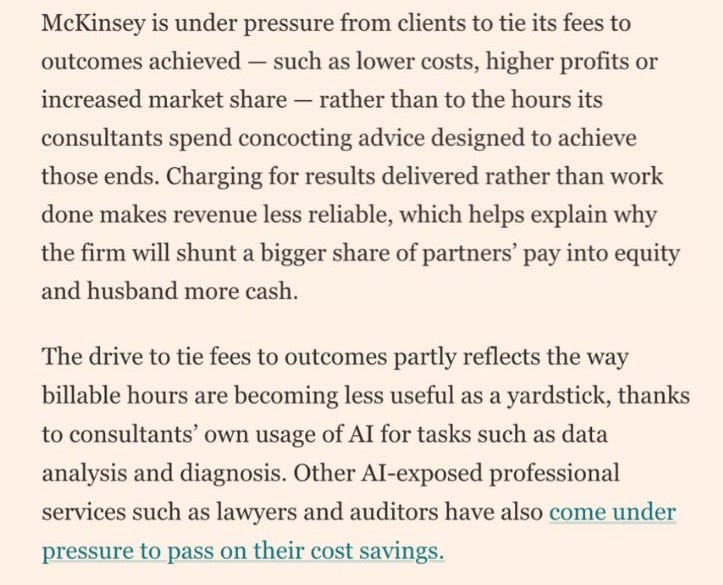
Recent Headline: AI is reportedly pushing McKinsey & rival consulting firms to rethink pricing, as clients are “questioning the value” of human advice, while clients are getting more used to fees based on successful task completion.
A note before this one. Escaping Generica is usually about the places we build and the systems that flatten them. This essay is about my old industry which builds these places, and what happens when their entire business model flips. It’s a detour. It will be back to streets and storefronts next week. But this is a thing I can’t stop seeing, and I owe it to the colleagues I left behind to write it down.
— /// —
Five years ago today, I retired as Vice President of a consulting firm where I’d spent the last decade building a multidisciplinary practice of engineers, planners and landscape architects.
Can’t believe it’s been that long.
The architectural and engineering consulting business was the only industry I really knew. Over three decades inside it. We had survived economic shocks and ridden waves of growth like any other industry.
I walked out of the building thinking it would still be there in twenty years, recognizable. Mature. Doing what it had always done.
I was wrong about that. I just didn’t know it yet.
Nobody inside that building did and might not still.
— /// —
For the last couple of years, I’ve been watching what’s happening with AI. Listening to the optimists who see breakthroughs coming in science, medicine, and education. Listening to the people worried about what it does to the industries and the jobs that disappear as we transition to something we don’t yet have a name for. And somewhere along the way, I started running both sides of that conversation through the lens of the industry I used to live inside.
I’m not trying to be a doomer about this. But I do think it’s something we have to look at clearly, and most of the industry isn’t yet.
It isn't a comfortable picture. But it isn’t unique to AEC, either. Most knowledge industries look this exposed when you hold them up to the light. Law, accounting, engineering, business consulting, financial analysis, medical diagnostics, anything where you sell expert knowledge by the hour. The shape of the disruption is the same. I’m only writing about this one because it’s the one I can speak to.
— /// —
What We Sold
For a century, architectural and engineering consulting firms sold one thing.
We sold what we knew, and the time it took to draw it up or write it down.
The deliverables were drawings, specifications, calculations, reports, plans. That’s what the invoice said. But the actual product was something else. The product was the accumulated knowledge of people who had done the work before, translated into documents that another set of people, contractors and clients and regulators, could read and act on.
The drawings weren’t the product. The drawings were a translation layer for our years of knowledge and expertise for our clients who didn’t have it.
Hold onto that sentence. We’ll come back to it.
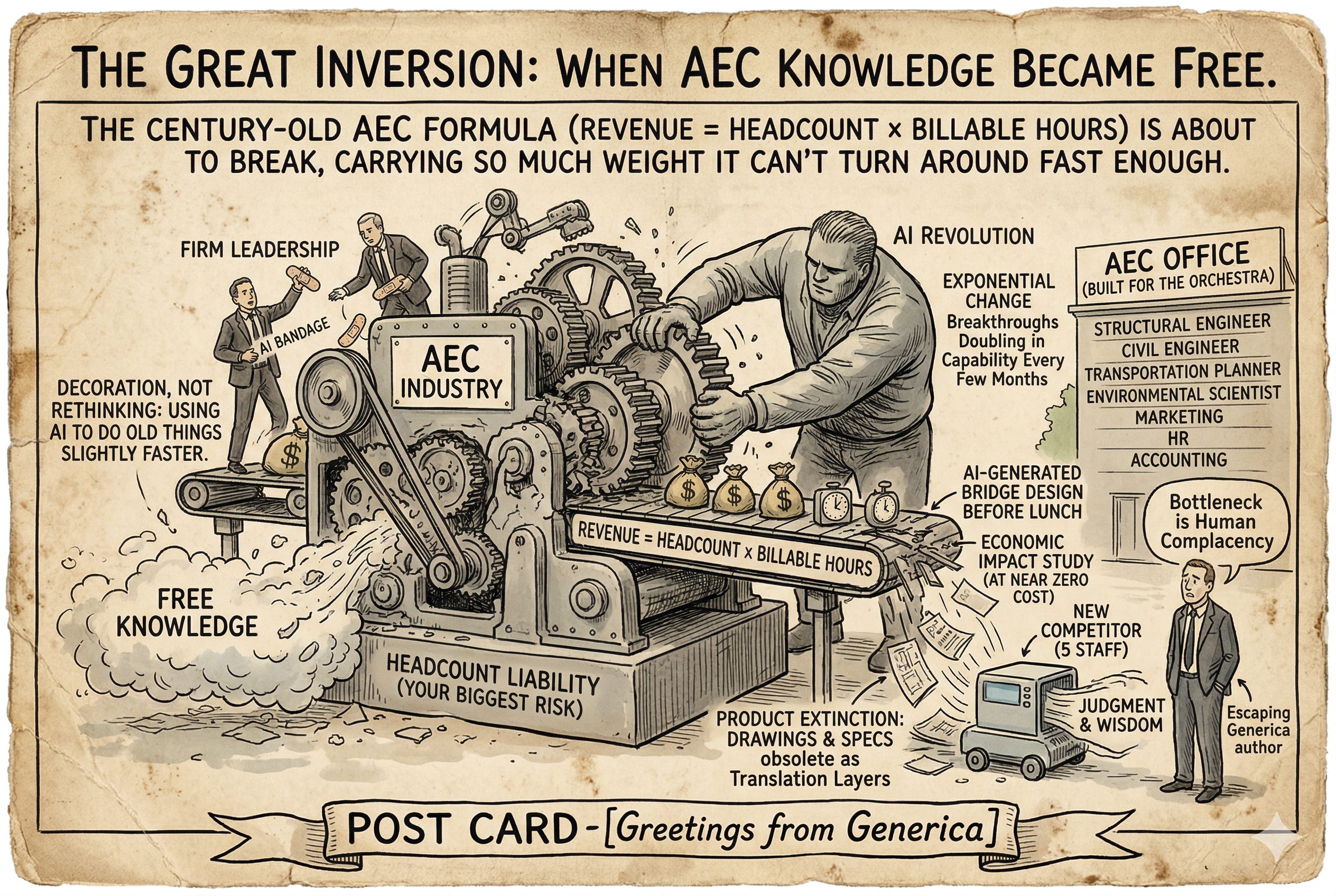
The business model that grew around this product was simple enough to write on a napkin. Revenue equals Headcount times Billable Hours. You hire people who know things. You sell their time. The more people you hire, the more time you can sell. The more time you sell, the more revenue you generate.
Every firm in the industry runs this equation. Every principal who built equity built it on this math. Every office lease, every benefits package, every Gantt chart, every proposal coordinator and HR manager exists to support the equation. The equation is the industry.
The Tailwind
I had a front row seat to the last technology revolution this industry absorbed.
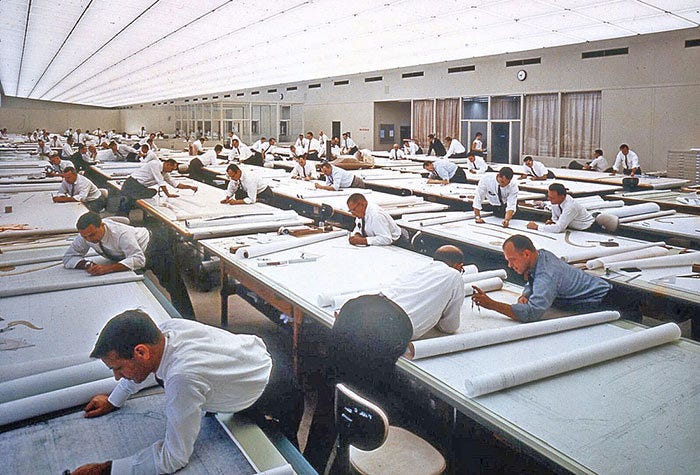
1990. I was the first employee my firm hired specifically to do “CAD”. I sat in front of a 13-inch screen running AutoCAD 10 while the colleagues around me were still bent over drafting boards. Rapidograph pens. T-squares and triangles. Ames Lettering Guide. Pounce powder. Yellow trace. Tools of the trade. All to draw a line.
Everyone thought CAD was digital drafting. Faster lines on a screen. And it was. We produced drawings faster while still charging as if we were drawing by hand. That arbitrage lasted less than a decade before competition eventually priced it in. The firms that adopted early made good money in the space between.
But digital drafting was just the beginning. CAD wasn’t a faster pencil. It was a different way of thinking about design. We didn’t see it yet, because the tool hadn’t shown us what it could do. 3D modeling. Revit. Building information systems. Renderings that let a client walk through a building that didn’t exist yet. None of it was imaginable when I was staring at that 13-inch screen.
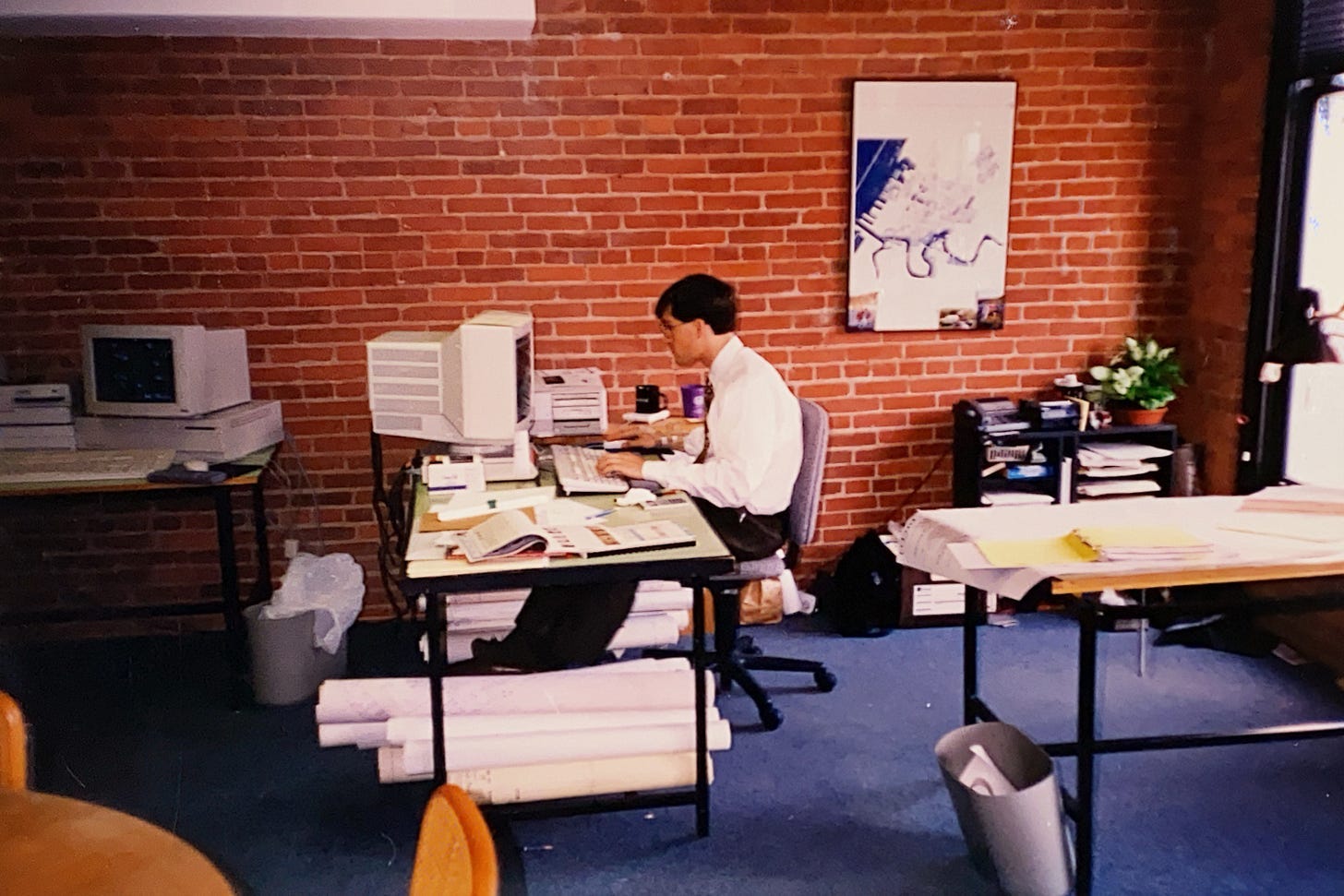
Through every wave of that revolution, the business model never changed. CAD let one drafter produce three times the drawings. BIM let one designer coordinate what used to take a team. Rendering let one illustrator deliver in a week what used to take a month to build a chipboard model. Each tool made every person inside the equation more productive. None of them touched the equation itself.
Headcount times Billable Hours just got more profitable.
For thirty years, technology was the gift that kept giving. Margins improved. Equity appreciated. The principals who lived through CAD, BIM, and rendering watched their firms make more money on the same staff, year after year. The lesson absorbed in every corner office was simple. New technology lifts the equation. You adopt it. You charge for it. You take home more.
That is the trap. Three decades of experience has taught the people running these firms that technology is a tailwind. They have no experience with technology as a headwind. They have no muscle memory for a tool that destroys the product instead of enhancing it.
AI is not the next CAD. AI is the headwind.
— /// —
The Inversion
On November 30, 2022, OpenAI released ChatGPT. Within two months, a hundred million people were using it. One of the fastest adoptions of technology in our history.
The AEC industry noticed. People went to conference sessions. Firms bought a few licenses. Someone used it to rewrite a project description. A project manager asked it to clean up a client email. IT departments wrote policy memos about what you could and couldn’t paste into it.
And then the industry went back to billing hours the way it always has.
I understand why. Even when a company identifies something like this, it has to move through the entire organization. Leadership has to commit. Middle management has to implement. The staff doing the work every day have to want to adopt it.
Most don't. Not because they're hostile. Because the old way still functions, and changing how you work when nothing is forcing you to is something most people just don't do. This is how mature industries die. Quietly, while still profitable.
So firms might be using AI for proposals, emails, and meeting notes. The same work, slightly accelerated. That’s not adoption. That’s enhancement.
Meanwhile, the real change is doubling every few months. Last month, Anthropic announced an AI model called Claude Mythos. It autonomously discovered thousands of zero-day vulnerabilities across every major operating system and every major web browser. Flaws that had been hiding in code for decades. Anthropic decided the model was “too capable” for public release. They sent it to about fifty critical institutions and a handful of federal agencies and told everyone else they couldn’t have it.
Three and a half years to get from “help me write this email” to a model the company that built it decided was too dangerous to release. That feels fast. But humans took two hundred thousand years to invent writing, five thousand to invent the printing press, four hundred to invent the computer, fifty to invent the internet. Two months for AI to reach a hundred million people. From the other side of the next three and a half years, today will look like the slow part.
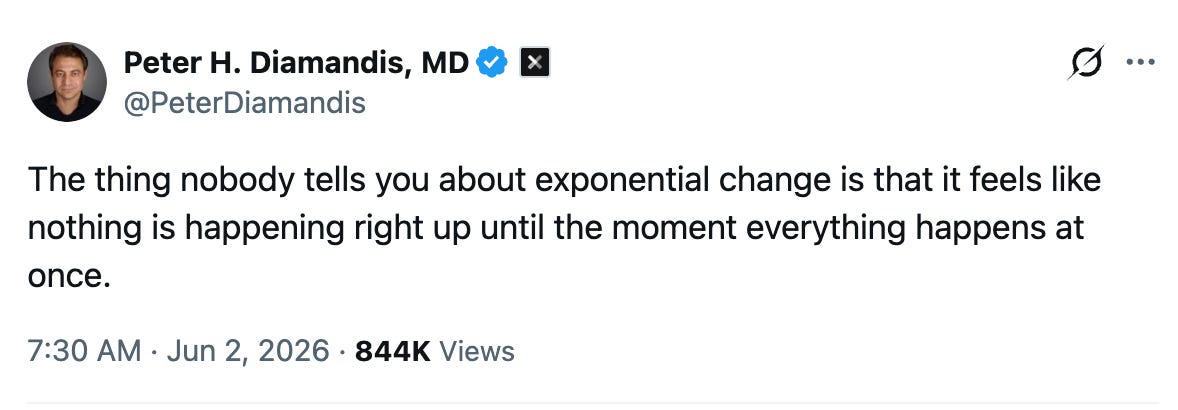
If capability is doubling every few months, the next three and a half years won’t look like the last three and a half years. They’ll look like something so much steeper that most of us have no frame of reference for it.
The 2022 version of AI wrote bad poetry. The 2026 version finds zero-day vulnerabilities humans missed for decades. That’s what doubling means. The curve doesn’t get more interesting. It gets unrecognizable.
This is not the curve the industry is preparing for.
Think about what it takes to engineer a bridge. Someone reads the geotechnical report. Someone runs the load calculations. Someone selects the structural system and the materials. Someone checks every requirement against the code. Someone produces the construction drawings, writes the specifications, produces the cost estimate. Each of those tasks is the kind of thing AI is already good at. Read a document and pull the numbers. Run a calculation against a code reference. Optimize a structural system against constraints. Generate a drawing from a specification.
None of those tasks, individually, is impressive anymore. The disruption is when you stack them. Read the report. Run the calculations. Select the steel. Check the code. Produce the drawings, the specs, the cost estimate. Hand it to the client.
That used to take a team of engineers months. It now happens in an afternoon.
Now go back to the sentence I asked you to hold.
The drawings were never the product. The drawings were a translation layer for our years of knowledge and expertise and the clients who didn’t have it. The asymmetry the industry sold for a century, the gap between expert and client, collapses.
That is not an efficiency gain. That is the extinction of the product, and every legacy anchor the industry built during its decades of growth becomes a liability overnight. The hundred-person office lease. The deep bench of technical staff. The administrative infrastructure. All of it built on a system where more people delivered more revenue. That system is ending.
Headcount may be the biggest risk on your balance sheet.
So if knowledge is almost free and tasks are nearly instantaneous, what exactly is your business model?
— /// —
What Survives
The expertise the industry spent a century accumulating, every code, every formula, every regulatory interpretation, every lesson from every failed project, is becoming something a client can access directly, for the price of a software subscription, in less time than it takes to schedule a meeting.
When that happens, the business model the industry was built on is gone. Headcount times Billable Hours can’t survive the moment when the hours collapse to zero and the knowledge itself stops being scarce.
So what’s left?
What’s left is judgment & wisdom.
Judgment is knowing that the most efficient highway route will cut a historic neighborhood in half and kill the entire bond measure. Reading a town hall well enough to understand that what people say they’re worried about isn’t what’s bothering them. Hearing a developer ask for code minimum parking and recognizing he actually needs help making the political case for less of it.
For now, the machine can’t do any of that. It can’t empathize with a frightened mayor. It doesn’t know when to push and when to fold. It doesn’t understand that sometimes the technically inferior option is the only one that’s actually buildable.
That’s what’s left. The human read on an inhuman problem. The ability to sit with chaotic, inarticulate needs and translate them into something the machine can solve, then translate the machine’s answer back into something a human institution can accept.
And here is the part that breaks the firm.
Judgment and wisdom don’t take a hundred people to deliver. It takes one person who knows what to do, and maybe a small handful around her who know how to support it. The AEC orchestra was built to translate expert knowledge into deliverables at scale. Judgment doesn’t scale that way. Judgment is a person reading a room and making a call.
That kind of work requires a completely different skill set than the one the industry has spent thirty years training. It’s not technical mastery. It’s emotional intelligence. Political navigation. Storytelling. The judgment to know when the right answer has to be unsaid.
Most of the people the industry has been promoting can’t do those things. Not because they failed. Because the firms never asked them to. The office went to the engineer who could manage a project well, not to the engineer who could read the mayor.
The industry is about to need a kind of person it spent thirty years not hiring. And it’s going to need a fraction of them.
And here is the question nobody has an answer for. Judgment in this industry was never taught. It was earned. You ran the calcs for ten years. You sat through a thousand meetings. You watched a senior partner read a room you didn’t yet understand. You got burned a few times. Eventually the technical reflex became a professional one.
That apprenticeship is about to disappear. If the machine runs the calcs, no one runs them in their twenties. If the machine writes the report, no one learns what a bad report looks like by writing one. The production work was never just production. It was the training ground for everything else. It was how judgment got built, one repetition at a time.
So the question isn’t only what the firm becomes. The question is where the next generation of people with judgment is supposed to come from when the road that used to make them has been paved over.
I don’t know the answer to that. Neither does anyone else I’ve talked to.
To be honest, this is the scary part.
— /// —
Missed an installment of Escaping Generica?
Why do our communities all look the same? Why can’t we build what we actually want? If you are just joining the conversation, you can catch up on the series here:
The Asymmetry: Why Your Dying Downtown Matters More Than Your Healthy Strip Mall
The Architecture of Consumption: How the Refrigerator Started Reshaping our American Cities
On Moments, Memory, and Why Most Cities Build the Forgettable
The Folding City: How Autonomous Vehicles Will Reprice, Reorder, and Restructure Urban America
Algorithmic Terraforming: Welcome to the Subscription Neighborhood
You’re Not a Neighbor. You’re a Data Point. Please Shop Accordingly.
The Physics of Economic Momentum: Why Efficient Markets Build Storage Units
— /// —
About Jeff Kerr: For thirty-five years I worked both sides of the same street. I engineered the footprints that national retailers stamp onto corridors, and I spent as much time, more, helping towns fight to hold onto what made them worth living in. I drew the formula and I drew the defense against it. That contradiction is the whole point. You don’t really see the machine until you’ve run it and resisted it. Escaping Generica is what I learned standing in the middle.
About Escaping Generica: A weekly dispatch decoding the physics of sameness, decay, and rebirth, why our towns lose their identity not to bad taste but to the National Retail Formula and the Market Entropy it sets loose, a system that always chooses the path of least resistance. Each essay takes apart one piece of the machine, how it works and why, and then asks the harder question: what it would take to build places that feel like somewhere again.
Join the Escape: escapinggenerica.substack.com
Almost 40 years with the same AEC company here. I started in 1980 and did not see a computer until the day a client walked in and asked "where are the computers?" Engineers could use them to develop spreadsheets but reports were written by hand and given to word processors to type.
Each adoption of new technology did not actually result in a major efficiency gain. There was some, but more gain came from the client/sales squeezing the budget for the next job and people having to adopt to keep their job.
When new technology made the job faster, the work load increased to match the budget. Do a heat and material balance by hand, and you're lucky to get 2 or 3 design iterations done before the project manager is yelling for the results. Experience meant learning about which assumptions were safe to make. With modelling software, you now can run hundreds of simulations with few assumptions, but you still work up to your budget.
So much of the field is changing because of outsourcing and fixed priced contracting. That has led some AEC firms into the more lucrative field of consulting. They hold the clients hand and they come up with the grand schemes as to how to improve the client's operation. At the other end, the AEC firms shift more into "boots on the ground" construction.
So, who might save some design engineers from obsolescence? The lawyers. AI can do all of the design work, but that work must be overseen and approved by a licensed engineer. Every detail needs to be checked. It's a matter of liability.