
The Space You Finish: Why the Best Public Spaces Leave Something Undone
We design for the eye. People inhabit with the body. That gap is everything.

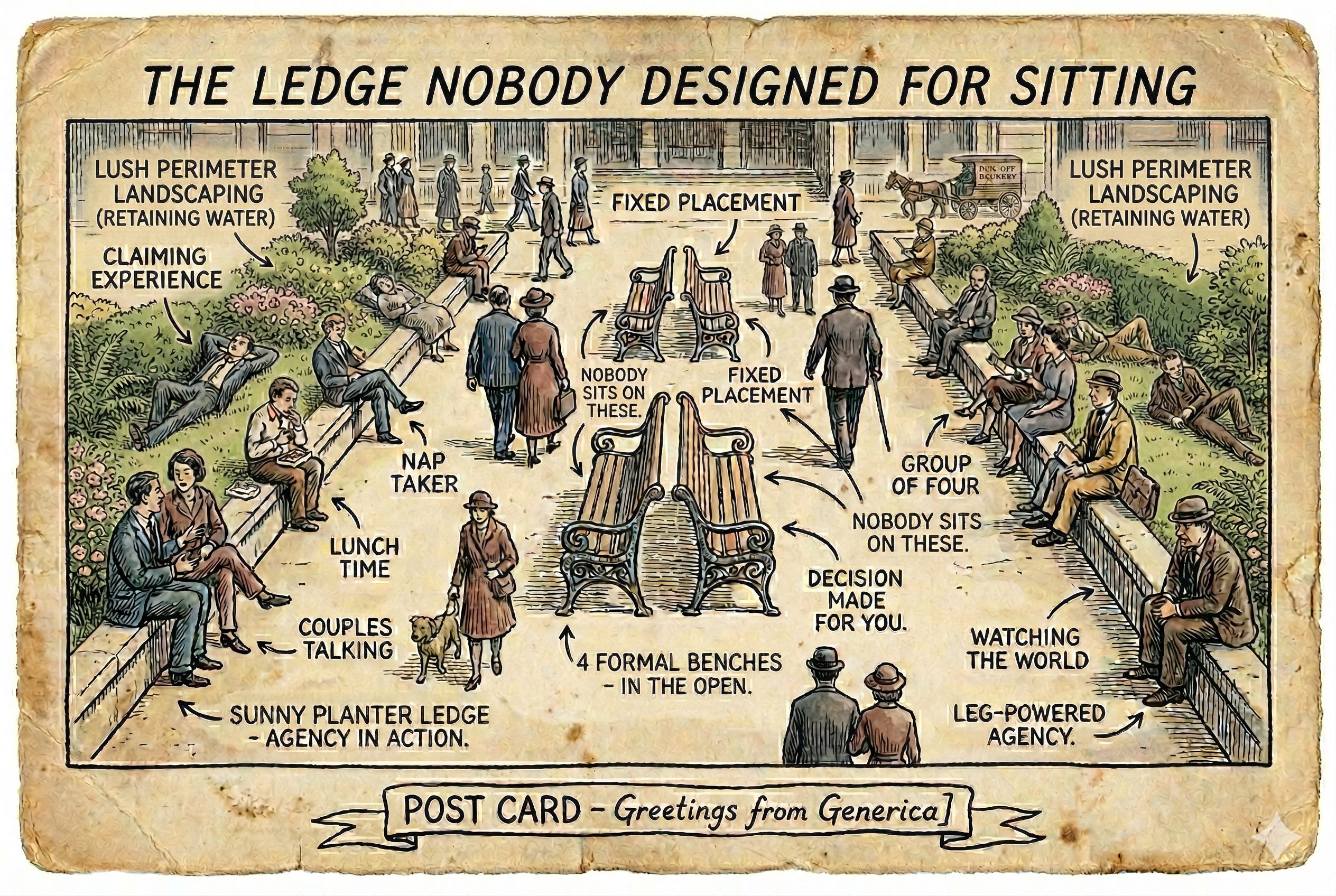
“He’d spent twenty years watching what people actually did in public space. Not what the design intended. What the body decided.”
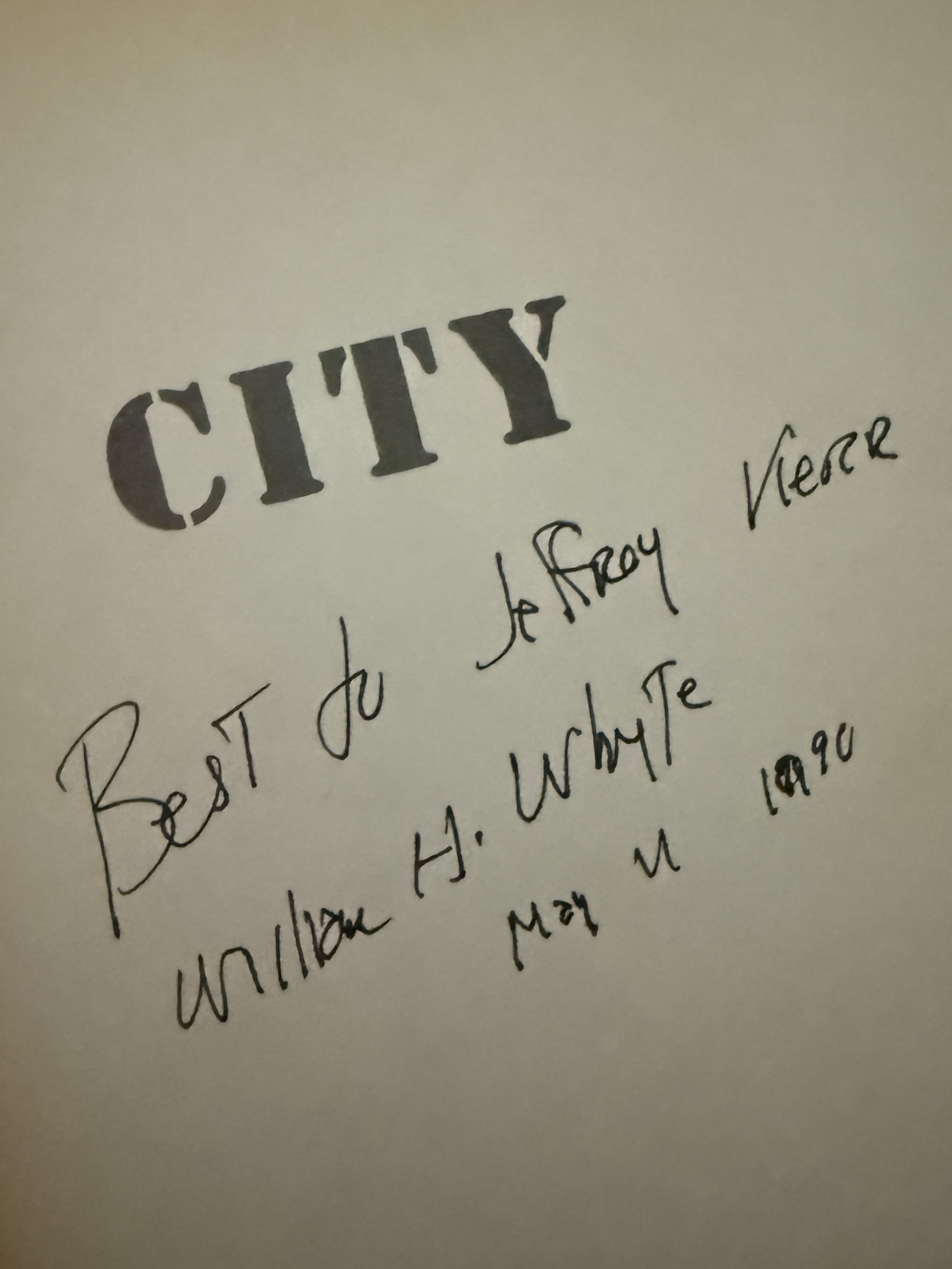
The book is still on my shelf. William Whyte’s signature inside the front cover. Dayton, 1990.
I was a Landscape Architecture student at The Ohio State University, and I’d driven from Columbus to hear him lecture. I’d read The Social Life of Small Urban Spaces probably three times by then — marked up, argued with in the margins, dog-eared at the pages that contradicted what I was learning in studio.
When his lecture ended, everyone else filed out.
I stayed.
“Mr. Whyte — could I ask you a few questions? For a paper I’m writing?”
He gave me fifteen minutes. He didn’t have to.
I came in with questions. He answered one and then turned it around. Looked at me directly and asked: “Why do you think people will walk right past a bench designed specifically for sitting — and then sit on a ledge that was never meant for that at all?”
I didn’t have an answer.
He did.
The bench tells you everything before your body arrives. Where to sit. Which direction to face. How close to be to the person next to you. The decision has already been made. Your job is to occupy the space the designer prepared for you.
The ledge offers you nothing except a surface at the right height. It says: figure it out.
That’s the difference. Not aesthetics. Not materials. Whether the decision has been made for you, or whether there’s still something for your body to figure out on its own.
I drove back to Columbus turning that over. I couldn’t stop.
I still haven’t.
The Dimension Without a Name (What the Studio Never Asked)
Landscape Architecture trains you to think in vistas and views. Circulation. Materials. How a path moves the eye through a sequence of space. How a grade change frames an arrival. How plantings directs your eye or how a canopy creates a room in the open air. Real craft. A serious discipline. We were taught to design places people could move through, find function, find beauty.
What the curriculum had almost no vocabulary for — what I’m not sure any design discipline teaches systematically — is the question Whyte spent two decades filming from a rooftop in Manhattan.
Not what a space looks like. What a body wants to do in it — not the body the designer imagined, moving through the space the way the section drawing predicted. We aren’t talking circulation routes. The actual person, with their own sun to find and their own distance to sort out, making decisions the design didn’t anticipate and can’t control.
Those are different questions. The whole professional apparatus — the studio critique, the design review, the award submission, the portfolio photograph — is organized around answering the first one. The second barely has language.
Think of it this way. When a person enters a space with no assignment, no programmed event, no instructions about where to go — what does the body reach for? What makes it stop instead of pass through? What makes it come back?
Whyte watched people answer those questions in real time for twenty years. And what he documented, over and over, was that people are relentlessly searching for small opportunities to exercise agency over their environment. Not grand gestures. Six inches. The exact patch of concrete where the afternoon sun sits right. The ledge that lets two people sort out their proximity without negotiating it out loud. The chair you could move.
He noticed something else too. People didn’t want to be on display. They wanted to watch the world. The most used spots in those plazas weren’t the ones that centered you in the composition — they were the ones that gave you a view out while keeping you on the edge of things. That chair dragged two inches isn’t just about light. It’s the mind asserting its own terms. Creating a small private arrangement in a public space. Deciding, however briefly, how this is going to go.
The moveable chair is the whole argument in one object.
A fixed bench is a completed design decision. Specifically selected shape, form, color, a tactical placement, and perfect height for the average human. It finishes the space. A moveable chair is an incomplete design decision — an acknowledgment that the designer doesn’t know where your sun is going to be, or whether you want to face the fountain or watch the entrance, or how close you need to be to whoever you came with. Whether you want to be closer to someone or just a little farther away. It leaves the unfinished work to the body that will actually live in it.
In that incompleteness, it is the most sophisticated thing a designer can do.
Because humans don’t just want agency over their environment. They need it. The woman dragging her chair two inches to find the right spot of light wasn’t being particular. She was doing something essential. That small muscular act — the scrape of the chair leg on concrete, the brief search for exactly right — is how a person stops being a visitor and becomes a temporary inhabitant. It’s how attachment starts.
You cannot claim a space you can only look at.
No-Man's Land (The Trail That Became a Place)
I’d been trying to build for this quality for years before I found the right problem. The Solstice Steps in Lakewood were the same instinct. Five massive concrete tiers, purposely awkward to navigate, nothing prescribing where you go or how you sit. You arrive at the edge of Lake Erie and these steps ask your body to figure out its own relationship to the water and the light. Some people lie flat. Some sit upright at the edge, some lean back against the step behind them. Some take a blanket and claim the whole tier. The steps are not comfortable in any conventional ergonomic sense — they’re too big, too blunt, too indifferent to your preferences. And that indifference is exactly what lets people connect to the place on their own terms. But the Steps had help. The sunset carried most of the weight. There was an occasion built in. People came with a reason.
The Towpath Mounds were harder.
The Ohio and Erie Canal Towpath Trail runs 101 miles through northeast Ohio. The Cleveland stretch is a well-built path — ten feet wide, perfectly graded, moving cyclists and joggers from one point to another with efficiency and care. Doing exactly what a trail should do.
There was a section I kept coming back to. Between West 7th and Quigley Road. Isolated from the street. Cut off on three sides by elevation and highway infrastructure. A no-man’s land that the trail was passing through, and nobody needed to stop in.
I felt — not calculated, felt — that something could happen here.
The Ohio and Erie Canal opened in 1832 and turned Cleveland into a city. Goods moved through the Cuyahoga Valley by water; the towpath was the working infrastructure, the corridor commerce traveled. A hundred and fifty years later, the recreational trail follows roughly the same route. Roughly. This stretch wasn’t historically close to the canal’s actual path. The connection here was more symbolic than literal.
We could have installed an interpretive sign. “If you look to your right, you’ll see the industrial valley that the Ohio and Erie Canal helped build. The Cuyahoga River carried the commerce of a region...blah, blah, blah.” Accurate. Respectful. The kind of thing you read and immediately forget.
A sign tells you what to think. It prescribes the meaning the same way the bench prescribes the sitting. Your job is to receive the information. Let us tell you what you should take from this.
I wanted the connection to live in the body, not the brain.
The Cuyahoga River valley is dotted with bulk storage piles — gravel, sand, iron ore pellets, the material residue of a century and a half of industrial commerce. Large conical forms that dot the riverbank. Working landscape. Mostly invisible unless you’re looking.
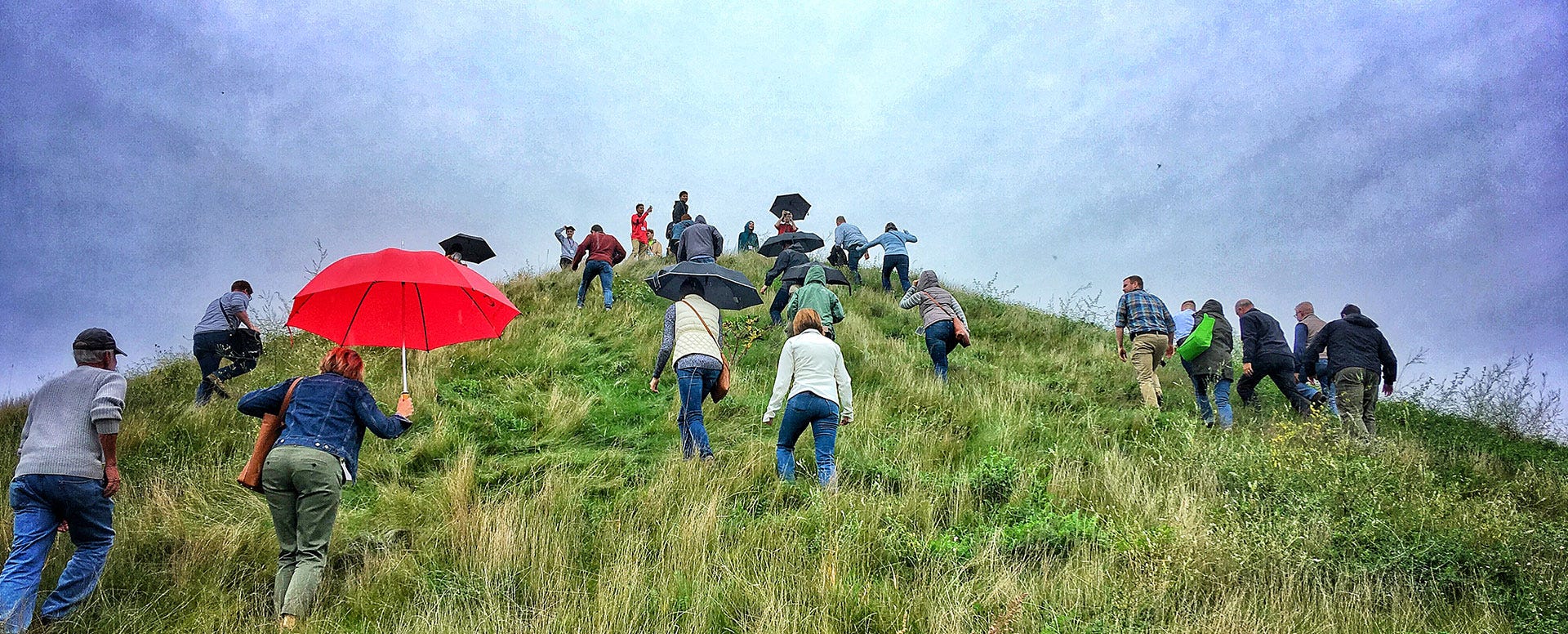
From both directions, the trail climbs a gentle but long grade to get to this place. Perfectly graded asphalt, same as the rest of the path. It could have been just another rise and descent. But as you crest it, seven large earthen mounds appear — each a slightly different scale, sitting there in a cluster that has no obvious explanation. The reveal is intentional. The dissonance is the point. Your brain registers something before your body has decided what to do about it.
We built seven earthen mounds alongside the path. Shaped symbolically after those huge piles of industrial materials. Large enough to feel wrong — too geometric, too deliberate, too present for the scale of the trail. The visual dissonance was not an accident.
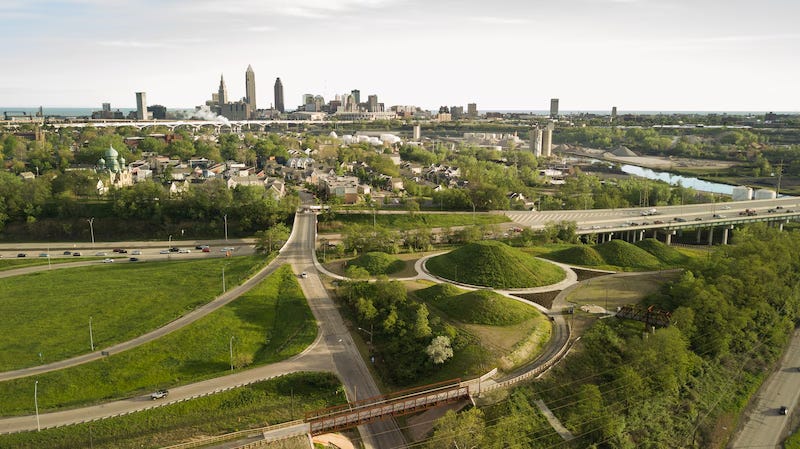
No sign. No instruction. No explanation of what you’re supposed to do. No path up the side. No steps. Not ADA accessible — deliberately. We didn’t want to prescribe the experience. We wanted each visitor to have agency over their own relationship to the form. Find your own way up. Decide where to go and how to get there.
The body figures it out. The grade is steep enough that for a moment it feels almost wrong — like you’re not supposed to be doing this, like there should be a path, like someone should have put in steps. That feeling is intentional. The slight resistance is the point. You’re making a choice, not following instructions. The legs commit before the head fully decides, and by the time you’re moving up the side of the mound you’ve already crossed from passing through into something else.
And from the top — the only point on the entire 101-mile trail where you get a full 360-degree view of Cleveland, the neighborhoods and the working industrial valley — you see what the canal workers saw. The same river. The same relationship between human effort and moving commerce, still operating below you a century and a half later.
You didn’t get that from a sign. You got it from your legs.
If you missed last week, read it now:
And here’s what Whyte would have filmed: you climb, and someone on the trail watches you climb. Now they have a reason to stop. Not a sunset, not a scheduled event. Just the sight of another body making a decision in a space that made it possible. The first act of claiming gives the next person permission.
There’s worn paths up the mounds now. Grass gone, earth compacted, the same line traced up the side by everyone who came before. No designer put it there. No maintenance crew cut it. It appeared because bodies kept making the same decision — here, this way, up — and the ground remembered.
That path is the quietest possible invitation. It doesn’t instruct. It just says: someone else already decided this was worth doing. Your body reads it before your brain does.
Trails are transportation networks. They move people from one point to another efficiently and that’s what we design them to do. The design question nobody asks is whether they can also be something else. Whether a body in motion can be interrupted — not diverted, interrupted — and choose to stay somewhere longer than it planned. Whyte called it dwell time. He measured it because it was the thing the profession wasn’t measuring. A trail that produces dwell time is doing something a trail isn’t supposed to do. It’s becoming a place.
A trail with a sign would have produced nothing like that.
The mounds almost didn’t get built. The objections were reasonable on their face: too expensive, unclear value, liability exposure on something climbable with no prescribed path. Nobody could point to a comparable project and say it worked. We were asking the client to fund something that the project scope didn’t asked for, in a strange location nobody thought of as a destination, on the argument that a place would emerge here, and the people who showed up would be the ones to make it.
We fought hard to keep them.
Nobody programmed the mounds as a destination. They became one anyway. I know because people started posting selfies from the top. Strangers with no connection to the project, no knowledge of the canal history, no reason to stop on an afternoon ride.
They stopped. They climbed. They stood at the top of something they hadn’t planned to climb and felt something worth sharing.
Think about what that photograph actually is. Not the designer’s portfolio shot — the empty space at golden hour, perfect composition, the rendering made real. The visitor’s own photograph. From the top of something their body decided. Proof they were there. That they did something in a specific spot in a no-man’s land between roads and elevation and history.
Whyte measured dwell time because dwell time was the thing the profession wasn’t measuring. The selfie on top of the mounds is thirty-five years later and the same data. Someone stopped their commute. Climbed. Stayed long enough to document it. Shared it.
That’s attachment. That’s a person saying, without words: I claimed this experience.
No sign produced that. No bench produced that.
A form that asked the body a question produced that.
The problem is that the lens we use to evaluate design often selects against it.
We have significant projects going up across Cleveland right now. Some of them will be beautiful. The renderings are compelling. The materials are considered. They’ll photograph well and maybe win something from their peers. What I’m less sure about is whether anyone has asked the harder question — not what will this look like, but whether anyone will live, even for a moment, in it.
That’s the question designers almost never ask. Because design culture is organized around prescription. The designer’s job is to anticipate the experience, shape it, deliver it complete. The bench in the right place, facing the right direction, at the correct height. The interpretive sign with the correct information. The programmed event in the activated space. All of it decided in advance. All of it arriving before the person does.
What Whyte was documenting in those plazas — what he tried to hand me in fifteen minutes in Dayton — was the opposite instinct. Not prescribing the experience. Delivering conditions where people establish their own attachment to a space, on their own terms, through their own physical decisions. That is genuinely harder to design for. It doesn’t render well. It can’t be guaranteed in a proposal. You can’t put that condition directly into your construction documents like you do specifying a bench.
And it’s rare. Whyte found it operating on a simple ledge nobody designed for sitting. On a fountain base a couple used for lunch because the height was exactly right. On a concrete step where strangers stood shoulder to shoulder watching a street performer and started talking.
A ledge. Not a bench. The difference between the two is the whole argument.
What Doesn't Render (The Specification We Keep Writing)
The book is still on my shelf.
Here’s what I spent thirty-five years trying to apply after that drive back from Dayton. Whyte wasn’t critiquing design. He wasn’t advocating for a different aesthetic. He was documenting a dimension of human experience that the discipline had no methodology to design toward. Not because designers don’t care about it. Because the tools we use to evaluate design — the rendering, the reviews, the portfolio photograph — can’t capture it well.
The photograph shows what the designer decided. It never shows what the body decided after the photographer left.
The woman dragging her chair two inches doesn’t render. The couple on the ledge ignoring the commissioned bench doesn’t make the award submission. The stranger who stopped mid-commute on a trail in Cleveland because something large and out of place asked their body a question.
All of it was the point.
We still have the metaphoric “bench” conversation in almost every design review. Does it relate to the material palette? Is it scaled correctly? Does it read well in the rendering?
We almost never ask: has a decision already been made here, or is there still something for a body to figure out?
The ledge respects your intelligence. The bench assumes it doesn’t need to.
We’re still specifying the bench. And telling people what to look at.
Whyte knew that in 1980. He tried to tell me in 1990. I've spent thirty-five years hoping I heard him right.
Missed an installment of Escaping Generica?
Why do our communities all look the same? Why can’t we build what we actually want? If you are just joining the conversation, you can catch up on the series here:
The Architecture of Consumption: How the Refrigerator Started Reshaping our American Cities
On Moments, Memory, and Why Most Cities Build the Forgettable
The Folding City: How Autonomous Vehicles Will Reprice, Reorder, and Restructure Urban America
Algorithmic Terraforming: Welcome to the Subscription Neighborhood
You’re Not a Neighbor. You’re a Data Point. Please Shop Accordingly.
The Physics of Economic Momentum: Why Efficient Markets Build Storage Units
— /// —
About Jeff Kerr
Jeff Kerr is a writer, urban observer, and reformed retail site engineer with 35 years of experience inside the development machine. He currently serves as Director of Planning and Policy for the Greater Sandusky Partnership, where he works on the exact problems he once helped create. He’s engineered footprints for national chains, sat through the planning meetings, run the spreadsheets. Now he writes Escaping Generica, a Substack series decoding how invisible systems shape the places we live. He writes from direct experience—not as an academic studying the problem, but as someone who helped create it and finally understands what he was building.
About Escaping Generica
Escaping Generica is a year-long essay series examining how American communities lose their distinctiveness to what Jeff calls “Market Entropy”—the invisible mechanisms that create sameness in the built environment. Drawing from decades inside development, retail engineering, and zoning appeals, Jeff decodes the systems most people sense but can’t name. This is testimony from the inside, written for planners, officials, developers, and anyone who wonders why every place looks like every other place. The escape starts with seeing the cage we’re in.
Join the Escape
Subscribe to Escaping Generica
Greetings from a fellow Ohio State Landscape Architecture Alum! Knew there was a reason I have become enthralled with your Substack entries. They feel relatable & it’s comforting to know someone is paying attention & not only recognizing but making others aware of things that most people take for granted in our World.