
The Signal Problem
We didn't build a process to hear what people think. We built one to hear what they feel strongly enough to say out loud.

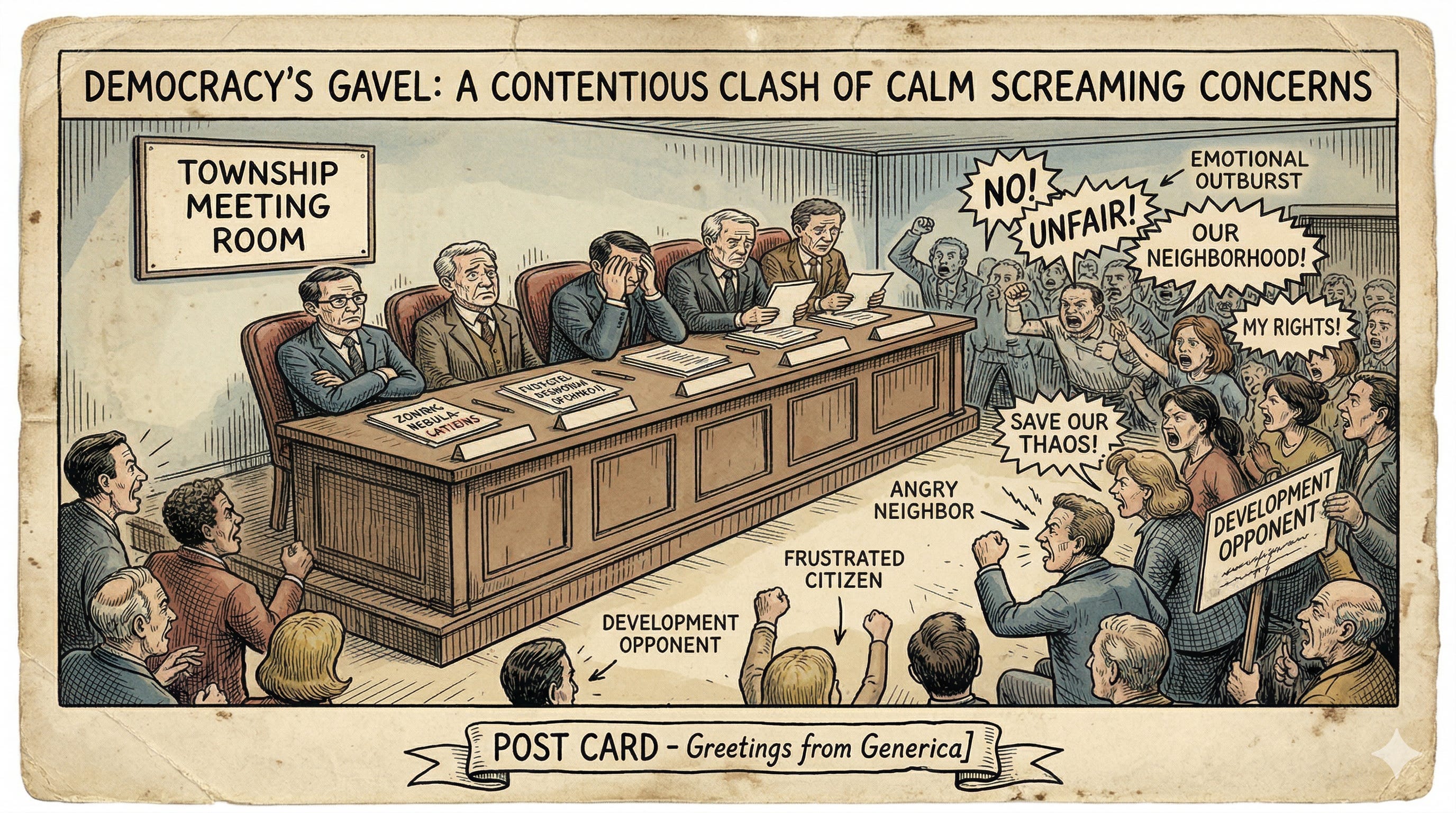
I knew it was going to be a long night when I couldn’t find a parking spot.
Our township lot is small. On normal meeting nights, most spaces sit empty. When I have to circle twice and wedge my car against the far curb, I already know.
I texted my wife: going to be late tonight.
Then I walked toward the building.
You can feel it before you open the door. Something in the air. An energy that isn’t there on routine nights, when the agenda runs forty minutes and the only people in the room are the board and one guy who needs a variance for a garage addition.
This was different.
I recognized most of the faces. Not from the neighborhood, exactly. From the room. They were the ones who showed up when something was happening they didn’t like. They knew the process. They knew how to use it. I didn’t think of them as bad actors. You can’t be a bad actor for showing up to a public meeting and saying what you think. That’s the point of public meetings. That’s the whole design.
What I kept thinking about was a conversation I’d had few days earlier, standing in a neighbor’s driveway. I mentioned the project. He shrugged. “Honestly, we could use more of housing around here.” Not enthusiastic, not opposed. A reasonable person giving a reasonable answer. He wasn’t going to be in that room. He had no reason to fight for anything.
Two other conversations that week. Different words, same shrug. We need more housing. Be nice to have something better there. Seems fine to me.
None of them were there.
The people who were there were not fine with it.
The Physics of Fear
Here is the thing about public process that every planner and board member learns fast and seldom says out loud: the process doesn’t measure what people think. It measures what they feel intensely enough to do something about.
Those are not the same thing. We’ve been treating them as the same thing for decades.
In 1979, Daniel Kahneman and Amos Tversky published the paper that would eventually win Kahneman a Nobel Prize. Their central finding sounds simple: losses feel roughly twice as powerful as equivalent gains. The pain of losing something you have generates about twice the psychological force of the pleasure of gaining something you don’t. “Losses loom larger than gains” is how Kahneman put it.
Nobody applied this to zoning hearings. They should have.
The people filling that parking lot were not there because they ran the numbers and found the project wanting. They were there because they felt like they were losing something. Their neighborhood. Their parking. Their sense of what this place is and who it belongs to. That feeling was real. The threat may or may not have been real, but the feeling absolutely was, and that feeling generated enough charge to put someone in a folding chair on a Tuesday night in a government building.
Here’s what makes this harder than it looks. The people in my neighbor’s driveway might have agreed with the project completely. More housing, better restaurant, sure, sounds reasonable. They weren’t indifferent to the idea. They were indifferent to the fight. A mild approval, even a genuine one, does not generate the same force as a felt threat. The emotional physics are not symmetric.
The process was built by people who assumed they were.
So the room fills with one kind of feeling, and the board tries to read the room.
What the Board Hears (And What It Doesn’t Know It’s Missing)
I’ve sat on both sides of those meetings — as a practitioner presenting projects, and later as a board member trying to weigh what came over the microphone. Let me be honest about something I never said out loud when I am sitting on that board: I never once believed the room was a representative sample. You know it isn’t. The people who showed up tonight are not a statistically valid poll. They’re a self-selected group sorted by intensity of feeling.
But the process gives you no other instrument. The board can only work with what walks through the door.
That’s not a criticism of boards or commissioners. It’s a description of the tool. Public hearings were designed to provide an outlet for community input, which is valuable and worth protecting. What they were not designed to do is measure community opinion, which is a different thing entirely. The problem comes when we make decisions as if they’re the same — when we treat the intensity of the room as a signal about the community, rather than a signal about the activated portion of it.
Research on planning meetings confirms what the Tuesday nights already tell you. Attendees are consistently older, more likely to own property, and more likely to oppose whatever is being proposed than the broader population they nominally represent (Einstein, Glick, and Palmer 2019).
The mild majority — the people in the driveways, the ones who think it seems reasonable, the ones who might genuinely want more housing or a better restaurant in their town — went home after work. The process moved forward without them, and no one in the room knew what was missing, because silence has no seat at the table.
What People Say They Want (And What They Oppose When It Arrives)
I’ve stood at the front of rooms like this one, presenting trail projects. Not housing. A trail — the kind of thing that shows up in every community survey as something people say they want. Hard to find the villain in a nature path.
And yet the opposition comes with a specific vocabulary. Crime. Strangers. Privacy. Kids in the backyard with a public path ten feet from the fence. Different words than housing hearings, where the vocabulary runs toward traffic and neighborhood character, but the same sentence underneath. I am afraid of losing control over who gets near the things I care about most.
The fear doesn’t require a real threat to be emotionally genuine. Those neighbors weren’t wrong to feel what they felt. They were wrong about what would happen. The trail opened. The feared crime didn’t come. The strangers who appeared were families with strollers and retirees with dogs. Some of the neighbors who fought hardest were out walking it within a year.
Here’s what stays with me. Those same people, six months before the proposal, would have told you their community needed more parks and trails. It shows up in every comp plan, every survey, every town hall. More walkable. More connected. Better quality of life. And they meant it. That wasn’t performance. People genuinely want those things for their community.
Then the trail arrives on a specific piece of ground next to specific houses, and something shifts. It’s no longer a community asset in the abstract. It’s a thing happening to them. The position they held rationally doesn’t stand a chance against what they feel emotionally. Belief lives in your head. Fear lives in your chest. When the two go to war, the chest usually wins.
The yes becomes a furious no.
That’s not hypocrisy. It’s plain old human behavior — hardwired, ancient, faster than thought. When something feels like a threat to what you love, the part of your brain built for survival takes over before the reasonable part gets a vote. Psychologists call it the amygdala hijack. The alarm fires. The body moves. The arguments come later, assembled to explain a conclusion the nervous system had already reached.
The abstract agreement never generated enough feeling to fill a parking lot. The specific threat did. And the process recorded what filled the parking lot.
It always does.
Reading the Room for What It Is
I’m not saying public hearings are broken or that the people who come to them are wrong to do so. The process needs engagement, and the people who show up are using the tools available to them in good faith. Showing up is the whole point.
The problem is what we pretend the room represents.
When a board votes after a contested hearing, it is acting on a signal. The signal is real. It tells you something genuine about the intensity of feeling in a community — who is activated, about what, and how strongly. That is useful information. A good board weighs it.
What the signal cannot tell you is whether the room reflects the community’s actual position. It can’t tell you how many people drove past on the way home from work and didn’t stop. It can’t tell you what those neighbors would have said on a survey, at a block party, in a driveway conversation where nobody’s sense of home felt immediately at stake. It can’t tell you what the comp plan said, what the community survey found, what people told you they wanted when you asked in a context that didn’t feel like a fight.
The process captures intensity. It doesn’t capture community opinion. A board that knows the difference is doing its job. A board that treats the room as the community’s final word is making decisions it doesn’t fully understand — and won’t know it, because the people who could have corrected the record never showed up to offer one.
That night, I found a spot at the far curb and walked toward the building.
The parking lot was full. I already knew what that meant.
It meant that one kind of feeling had enough charge to get there on a Tuesday night.
It meant that a decision was about to get made.
It did not mean the community had spoken.
It never does.
The RFI (Request for Insight): Think about the last time something changed in your community that you weren’t wild about but didn’t go fight. What would it have taken to move you? And if the honest answer is “nothing short of something I was genuinely afraid of losing” — what does that tell you about who has been making decisions for your town?
Missed an installment of Escaping Generica?
Why do our communities all look the same? Why can’t we build what we actually want? If you are just joining the conversation, you can catch up on the series here:
The Tragedy of the Convenience — Apr 21
The 45 MPH Architect — Apr 14
Finding your Hometown Edge — Apr 7
The Infrastructure of Love: Why Pembroke’s Murals Matter More Than Its Streets — Mar 31
The Asymmetry: Why Your Dying Downtown Matters More Than Your Healthy Strip Mall — Mar 24
The Stolen View: Property Rights and the Land You Don’t Own — Mar 17
The Folding City: How Autonomous Vehicles Will Reprice, Reorder, and Restructure Urban America — Mar 10
Algorithmic Terraforming: Welcome to the Subscription Neighborhood — Mar 3
You’re Not a Neighbor. You’re a Data Point. Please Shop Accordingly. — Feb 24
On Moments, Memory, and Why Most Cities Build the Forgettable — Feb 3
— /// —
About Jeff Kerr Jeff Kerr is the Director of Planning & Policy at the Greater Sandusky Partnership. He spent 35 years inside the development machine — engineering retail footprints, running site selection models, and building the landscape he now spends his time trying to explain. Escaping Generica is his attempt to testify about what he saw.
About Escaping Generica Escaping Generica is a weekly dispatch from the front lines of a culture losing its sense of place. It decodes the invisible systems — financing, zoning, retail economics, traffic engineering — that shape the built environment most people sense is wrong but can’t name. Written for planners, developers, community leaders, and anyone who has ever driven through an unfamiliar city and felt, with certainty, that they’d been there before.
You're lucky that your process even listens. Here in Los Angeles and many major cities, we've built a system for people to be ignored. Pay $20 to park, wait hours upon hours to provide comment, get 1 minute of time to be heard, and during that time have council members yack, yawn, get up, and walk away. We have a city attorney who bemoans the public insults that occur at Board meetings, how it's so upsetting and disrespectful. The same attorney who when asked for help replies "sorry, our hands are tied" or who gives false info to councilmembers so they won't oppose any development projects. None of them talk about how disrespectful their actions are to the public. And if you submit written comments, they are ignored too. There's zero effort made to even acknowledge receipt of comments. Not that it matters, since the council votes are worked out prior to the meeting so there's zero need to listen.